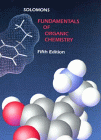
1. Fundamentals of Organic Chemistry, 5th ed., T.W. Graham Solomons
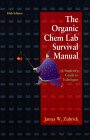
2. The Organic Chem Lab Survival Manual, 5th ed., Zubrick
(Recommended) Study Guide to Fundamentals of Organic Chemistry, 5th ed., Solomons & Fernandez
TEXTS
1. Fundamentals of Organic Chemistry, 5th ed., T.W. Graham Solomons
2. The Organic Chem Lab Survival Manual, 5th ed., Zubrick
(Recommended) Study Guide to Fundamentals of Organic Chemistry, 5th ed.,
Solomons & Fernandez
ADDITIONAL MATERIALS
1. Bound notebook for laboratory
2. Safety goggles as required by Department
3. Protective gloves
(Recommended) Darling Flexible Stereochemical Models
MODES OF EVALUATION
Organic Chemistry is very much like a language. As with any language, mastery is only possible with regular practice. Accordingly, homework assignments following the enclosed Class Schedule will be given daily. It is expected that the assignment will be completed before the next lecture. Homework will be assigned to help clarify important concepts; however, homework will not be collected and will not directly affect the course grade. Homework does, of course, affect the grade in that it is unlikely that the course content can be mastered without significant practice. Self-evaluation of homework will be possible through the use of the Study Guide.
A brief quiz covering recent lecture material will normally be given at the beginning of every other class period. The first quiz will occur on the fourth day of class. Regular attendance is, thus, necessary to achieve success in the course. The three lowest quiz scores will be discarded when calculating the final quiz score. Make-up quizzes will not be administered under any circumstances. All quizzes are closed-book, closed notes.
Three Opportunities will be administered on the dates listed below. Make-ups will be given only under extreme circumstances (illness, serious personal difficulty). The third opportunity will occur during the final examination period established by the registrar. This opportunity will be cumlative over all reactions covered during the semester and will also include sections regarding theory from the chapters which were not previously covered in Opportunity #1 or #2. All opportunities are closed-book, closed-notes.
Laboratory work will be assessed in the following way. A student is expected to attend all labs (or makeup assignment if missed through excusable absence), properly utilize a laboratory notebook (which will be subject to examination without notice), show evidence of preparation for lab (through lab quizzes, flowcharts, etc.), and strictly adhere to all chemical hygiene rules. It is usually very difficult to make up missed labs, thus it is essential that lab attendance be very faithful. The lab grade begins at 100% and will be decreased by 10% for each nonperformance of the expected standards. After a one time grace period (no penalty), upon violation of a chemical hygiene rule, the student will be asked to leave the lab for the remainder of the class period. This will result in two reductions to the lab grade (chemical hygiene violation, nonexcused absence).
Laboratory notebooks will be prepared by the student and will be assessed by a combination of self-evaluation and peer-evaluation (neither of which will affect the actual grade in the course) and by evaluation by the lab instructor. Students who perform all laboratory work, observe all chemical safety regulations, and maintain an acceptable laboratory notebook will receive full credit for laboratory effort (representing 67% of the lab grade). During the final laboratory session, a laboratory examination will be administered. The score on this examination represents 33% of the lab grade.
Scores on graded materials are not curved. Final grades will be computed as follows:
45% - Three Opportunities
30% - Quizzes (drop three low scores)
25% - Laboratory (includes lab exam)
MISCELLANEOUS INFORMATION
This course will endeavour to make us of the computer as tool to aid communication, to enhance learning and to provide reference information. To encourage students to take advantage of this resource an online study session run by the professor will be scheduled on a weekly basis. This is made possible by use of AIM (AOL Instant Messenger). This application is available from America Online for no cost. Specific instructions will be presented in class prior to the first online study session.
Make-up examinations will be allowed only if the absence is previously cleared with the instructor or in the event of an emergency. In the case of illness, a written excuse from the health center is required. In the case of a personal emergency, a note from the Center for Student Development is required.
Make-up quizzes are not administered under any circumstances.
Students with documented disabilities must identify themselves in writing no later than the second Friday of classes in order for an accommodation to be made available.
| Meeting(s) | Chapter | Topic |
|---|---|---|
| 1 | --- | Syllabus and Introduction |
| 2-4 | 1 | Carbon Compounds & Chemical Bonds |
| 5-7 | 2 | Representative Carbon Compounds |
| 8 | 2 | Relationships Between Physical Properties and Molecular Structure |
| 9 | 3 | Acids & Bases in Organic Chemistry |
| 10-13 | 4 | Alkanes: Nomenclature, Properties & Conformational Analysis |
| 14, Sep 29 | --- | * * * OPPORTUNITY #1 * * * |
| 15,16 | 4 | Conformational Analysis of Cycloalkanes |
| 17,18 | 4 | Synthesis, Backwards then Forwards! |
| 19-22 | 5 | Stereochemistry |
| 23-27 | 6 | Reaction Mechanism & Competition: Nucleophilic Substitution & Elimination |
| 28-31 | 7 | Alkenes and Alkynes. Properties & Synthesis |
| 32 | --- | Catch-up |
| 33, Nov 15 | --- | * * * OPPORTUNITY #2 * * * |
| 34-37 | 8 | Alkenes and Alkynes. Ionic Addition Reactions |
| 38-40 | 9 | Radical Mechanisms. Alkane Halogenation |
| 41,42 | --- | Selected Special Topics; Preparation for Final Examination; Retrosynthesis Redux, Selected examples. |
| Dec 19, 8-10am | --- | * * * OPPORTUNITY #3 * * * |
Note: Laboratory is preceeded by a mandatory pre-lab lecture. Reading: chapter numbers below refer to reading required from The Organic Chem Lab Survival Manual before arriving on the lab day. Handouts will be provided online (links below) or in hard copy. Failure to read the required material before arrival at lab may result in a reduction in the laboratory grade.
| Meeting | Reading | Topic |
|---|---|---|
| Sep 5/6 | 1, 2, handout | Check-in, Orientation; "Powers of Observation" |
| Sep 12/13 | 3,12, handout | Melting Point Determination and Significance |
| Sep 19/20 | 9, 11, 13, 17, 18 handout | Crystallization: Acetanilide |
| Sep 26/27 | 4, 19, 20, handout | Simple and Fractional Distillation |
| Oct 3/4 | 31, handout | Gas Chromatography of Distillate Fractions |
| Oct 10/11 | handout | Steam Distillation of Clove Oil Supplementary Reading (optional): Ethnopharmacology |
| Oct 17/18 | handout, 10, 15, | Isolation of Clove Oil |
| Oct 24/25 | handout | Country Chemistry: Ma Pearl's Oatmeal Soap |
| Oct 31/Nov 1 | handout | Using the Chemical Literature |
| Nov 7/8 | 33, Solomons 13.3 handout | Infrared Spectroscopy |
| Tues, Nov 14 | --- | * * * NO LABORATORY * * * |
| Wed, Nov 15 | handout | Williamson Ether Synthesis, SN2 Reaction |
| Tues, Nov 21 | handout | Williamson Ether Synthesis, SN2 Reaction |
| Wed, Nov 22 | --- | * * * NO LABORATORY * * * |
| Nov 28/29 | handout | Dehydration of 2-Methylcyclohexanol |
| Dec 5/6 | handout | GC of Dehydration Product |
| Dec 12/13 | --- | Laboratory Exam; Check-out |