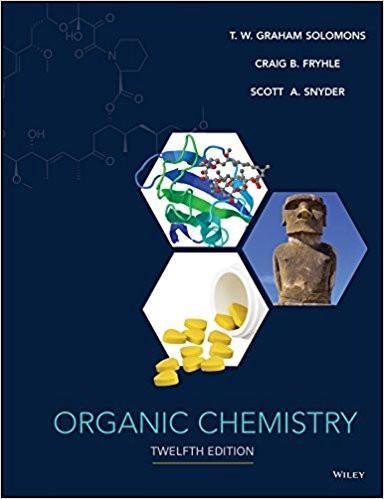
1. Organic Chemistry, 12th ed., Graham Solomons & Craig Fryhle
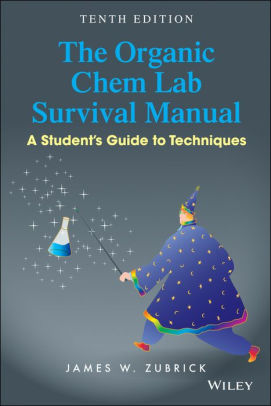
2. The Organic Chem Lab Survival Manual, 10th ed., Zubrick
(Recommended) Study Guide to Organic Chemistry, 11th ed., Solomons & Fryhle
| Prof. Irvin J. Levy, Lecture and Lab L1 Ms. Verna J. Curfman, Labs L2 & L3 Office Hours: MWF, 9:10-10:10 MW, 12:30-1:30 Tu, noon-1:00 or by appointment |
This semester we will expand our intitial understanding of green chemistry by producing outreach projects to enhance green chemistry literacy for others.
TEXTS
1. Organic Chemistry, 12th ed., Graham Solomons & Craig Fryhle
2. The Organic Chem Lab Survival Manual, 10th ed., Zubrick
(Recommended) Study Guide to Organic Chemistry, 11th ed., Solomons & Fryhle
ADDITIONAL MATERIALS
1. Bound notebook for laboratory
2. Safety goggles as required by Department
MODES OF EVALUATION
Organic Chemistry is very much like a language. As with any language, mastery is only possible with regular practice. Accordingly, homework assignments following the enclosed Class Schedule will be given daily. It is expected that the assignment will be completed before the next lecture. Homework will be assigned to help clarify important concepts; however, homework will not be collected and will not directly affect the course grade. Homework does, of course, affect the grade in that it is unlikely that the course content can be mastered without significant practice. Self-evaluation of homework will be possible through the use of the Study Guide.
A brief quiz covering recent lecture material will normally be given at the beginning of every other class period. The first quiz will occur on the fourth day of class. Regular attendance is, thus, necessary to achieve success in the course. The three lowest quiz scores will be discarded when calculating the final quiz score. Make-up quizzes will not be administered under any circumstances. All quizzes are closed-book, closed notes.
Since the ability to communicate effectively is a key to success in scientific endeavors, a service-learning assignment (the Green Organic Literacy forum, or GOLum) is an important element in this course. GOLum will engage a team of several students in the preparation of a useful end product to communicate the principles of green chemistry to an audience external to this course. Due to the complexity of this project, several intermediate milestones are due (see below). Failure to observe these due dates will result in a one-half letter grade reduction in the final project grade for each milestone missed.
Three Opportunities will be administered on the dates
The final examination will be a multiple choice standardized American Chemical Society examination which is cumulative over both courses.
Any student scoring at the national 90th percentile or higher on the this exam will automatically receive a grade of A in the course provided
all laboratory work has also been completed. The study guide for this examination is available for purchase
from the ACS at this link.
Laboratory work will be assessed in the following way. A student is expected to attend all labs (or makeup assignment if missed through excusable
absence), properly utilize a laboratory notebook (which will be subject to examination without notice), show evidence of preparation for lab
(through lab quizzes, flowcharts, etc.), and strictly adhere to all chemical hygiene rules. It is usually very difficult to make up missed labs,
thus it is essential that lab attendance be very faithful. The lab grade begins at 100% and will be decreased by 10% for each nonperformance of the
expected standards. After a one time grace period (no penalty), upon violation of a chemical hygiene rule, the student will be asked to leave the
lab for the remainder of the class period. This will result in two reductions to the lab grade (chemical hygiene violation, nonexcused absence).
Laboratory notebooks will be prepared by the student and will be assessed by a combination of self-evaluation and peer-evaluation (neither of which
will affect the actual grade in the course) and by evaluation by the lab instructor. Students who perform all laboratory work, observe all chemical
safety regulations, and maintain an acceptable laboratory notebook will receive full credit for laboratory effort (representing 67% of the lab
grade). During the final laboratory session, a laboratory examination will be administered. The score on this examination represents 33% of the
lab grade.
GREEN ORGANIC LITERACY FORUM (GOLum) ASSIGNMENT
Last semester was a time to gather with a team and develop a plan for a GOLum project. This semester you will bring your project to
completion. Several important dates apply to the various milestones in the project. The timely submission of all items is essential to success in the project.
Details of the milestones follow. Milestones will only be accepted electronically (unless previously arranged) by submission to smeagol01984@gmail.com with all
needed files attached. All milestones are due no later than 5pm on the due date. Submissions received after the 5pm deadline will be penalized.
Milestones
In this milestone all of the members of your team will gather with the professor to discuss current
status of the project, assess accomplishments, and clarify the tasks that remain. Every member of the team must
attend this 15-20 minute meeting which will be scheduled in advance.
In this milestone you will report the following:
Based on the purpose of your project, you need to develop specific expertise in green chemistry as well as having general
knowledge of the topic. In this assignment you are to compile resources (books, articles, web resources, people, etc.) that can be used
to support your outreach and to provide your "training" as you prepare to reach out. Include
a descriptive entry for every web site, article, book, handout, or person (other than your team members or your professor) that is
relevant to your project. Note: this is a very individualized milestone.
You are to resubmit your Team Report (from the previous milestone) noting what tasks have been accomplished and altering the timeline
as needed. Add a paragraph that clearly states change in the report from the previous version and the reason for those changes.
During the months of March and April, projects will be nearing completion. Teams will need peer support to complete their projects. For
example, if students produce a video, they will need others to critique their script or raw footage; if students produce written materials,
they will need others to critique their written work; if students prepare new lab activities, they will need others to test their activities;
if students are visiting a high school, they will need an audience on our campus to run a "dress rehearsal".
Each student in the class will be required to perform two (2) critiques in support of their peers. In order for a critique to count, the student must
first confirm (verbally) with the professor that the critique is permitted (for example, I can't have 20 people critique the same video!). Unless otherwise
directed, credit is received when the student sends a WRITTEN critique to all members of the team along with a copy to smeagol01984@gmail.com. In order to
receive credit, the written critique must be submitted within seven (7) days of the peer review.
Your team will submit a white 1/2" binder containing the following:
ASSIGNMENT WEIGHTS
Final grades will be computed as follows:
MISCELLANEOUS INFORMATION
Make-up quizzes are not administered under any circumstances. Ever.
You are always welcome to request the quiz that you missed and
you will always be able to receive feedback after you attempt the questions. You just won't receive credit.
If you had several unavoidable absences on quiz days you are encouraged to bring this to the professor's attention
at the end of the course. If your final grade will be changed by dropping an additional "low
score" then that may be possible.
Make-up examinations will be allowed only if the absence is previously cleared
with the instructor or in the event of an emergency. In the case of illness, a
written note from the health care provider is required. In the case of a personal
emergency, a note from the Center for Student Development is required.
Academic dishonesty is regarded as a major violation of both the
academic and spiritual principles of this community and may result in a
failing grade or suspension. Academic dishonesty includes plagiarism,
(see Plagiarism in Student Handbook), cheating (whether in or out of the
classroom), and abuse or misuse of library materials when such abuse or
misuse can be related to course requirements.
Gordon College policy states that for each semester hour of credit, students should expect to spend a minimum of
2-3 hours per week outside of class in engaged academic time. This time includes reading, writing, studying,
completing assignments, lab work, or group projects, among other activities.
Students with disabilities who need academic accommodations are asked to
speak with the instructor within the first two weeks of class. Students
are also responsible for making sure that documentation of the
disability is on file in the Academic Support Center. Failure to
register in time with the leader and the ASC may compromise our ability
to provide the accommodation.
GRADE COMPUTATION
USB data drive with relevant documents, handouts, photos, and copy of all of the following materials 1 USB drive Name of project and team members
Brief bio statements (with photos) and abstract1 page maximum Description of the audience, including total number directly reached about 1 page Description of the presentation forum about 1 page Mirror: Copies of all material presented for the audience variable, 5-15 pages Final annotated bibliography variable, 1-10 pages Final action plan 1-2 pages Written critiques from peers 1-3 pages Your own critique, analysis of outcomes, suggestions for future work 1-2 pages
Scores on graded materials are not curved unless otherwise indicated.
10% - Opportunity #1
10% - Opportunity #2
10% - Opportunity #3 (final exam week)
10% - Final examination (curved)
20% - Quizzes (drop three low scores)
20% - GOLum
20% - Laboratory (includes lab exam)
	A+   >97            B+	(87-90]         C+	(77-80]	        D+	(67-70]
	A    (93 - 97]      B	(83-87]         C	(73-77]	        D	(63-67]
	A-   (90 - 93]      B-	(80-83]	        C-	(70-73]	        D-	(60-63]
Jan 16 Syllabus Welcome
The path forward - GOLum and lecture
Schedule GOLum team meetings
Homework:
Work on reaction facts
Facts list, for handy access
Spreadsheet for updating
Assignment
Jan 18 --- Chapter 1-10 Q&A Session
Each student is requested to bring at least one question about a topic - anything -
the s/he was not 100% sure about in Organic 1. The session will be spent
answering those questions.
Topics: Acid/base "basics"; predicting a reaction mechanism
Your questions
Acid/base table
Reaction Mechanism pathway handout
Predicting a reaction mechanism slides
---------------------
*** GOLum Team Meetings w/Professor this week - Milestone #1
Jan 21 --- No class today to commemorate Rev. Dr. Martin Luther King
Martin Luther King's famous "I Have A Dream" speech: video
LAB, Jan 22 Reaction facts and multistep synthesis
Team project - no prelab preparation required
Bring Reaction Fact sheets from last semester (see above)
Jan 23 11.1-6,10 Alcohols: Synthesis & Reactions involving the O-H bond
*** Reaction facts assignent is collected in class
*** GOLum Milesone #2 Due January 28
GOLum team meeting this week
Team Report, one per team, emailed to smeagol01984@gmail.com
Work on worksheet for first portion of chapter 11 -- bring your work to class tomorrow.
Jan 25 11.12,14,15,17 Ethers: Reactions
Discussion of worksheet -- questions answered.
Homework:
11.3, 11.4, 11.5, 11.6, 11.9a, 11.12, 11.17, 11.18,
11.26abej, 11.28, 11.33, 11.34 (Skip GHI), 11.37, 11.40de
---------------------
Jan 28 --- No class today. Meet with GOLum team to complete milestone #2
and mail to smeagol01984@gmail.com
LAB, Jan 29 Sodium borohydride reduction of a ketone: Preparation of meso-hydrobenzoin
handout
Jan 30 --- no class today - complete worksheet from professor
Feb 1 11.7-9,11,13 Discuss worksheet on
Alcohols: Reactions involving the R-O bond
Ethers: Synthesis
Homework:
See Jan 23
---------------------
Feb 4 12.1-3 (skip 12.3D) Introduction to organic redox reactions
Reductions: Alcohols from carbonyl compounds
QUIZ #1 Today
Homework:
TBA
Work on chapter 12 worksheet
LAB, Feb 5 MULTISTEP SYNTHESIS - WEEK #1
benzyl alcohol --> benzaldehyde
handout
Feb 6 Discuss Chapter 12 worksheet on these topics:
12.5-8
12.4 (skip 12.4AB) Oxidations: Synthesis of carbonyl compounds.
Homework:
12.3, 12.5abcd, 12.14, 12.17, 12.18abde, 12.19, 12.25
The Grignard Reaction
Homework:
12.8, 12.9, 12.11, 12.24, 12.34
Take home quiz distributed - Synthetic Interlude
Feb 8 Chapter 12 concluded --- Take Home Quiz Collected ---
---------------------
Feb 11 13.1-4 *** GOLum Milesone #3 Due February 11
Annotated Bibliography & Revised Team Report
emailed to smeagol01984@gmail.com
Conjugated Unsaturated Systems
The Game of Resonance handout
Conjugation, delocalization, resonance, stability
Homework:
13.2, 13.3, 13.4, 13.5
LAB, Feb 12 No lab this week
Feb 13 13.5-7, 13.9 Conjugated Unsaturated Systems: Conjugated Dienes
Synthetic Interlude collected today
Homework:
13.6, 13.9, 13.13, 13.14, 13.32, 13.33
Feb 15 13.9-10 QUIZ #2 today
Dienes and the Diels-Alder Reaction
Discussion of name reactions in organic chemistry
Homework:
13.14, 13.15, 13.16, 13.39, 13.40, 13.43
---------------------
Feb 18 14.1-4 Aromaticity, introduced
Homework:
14.1, 14.16abcdefghjkmnpqr
LAB, Feb 19 MULTISTEP SYNTHESIS - WEEK #2
benzaldehyde --> benzoin ; handout
Feb 20 14.5, 14.6A Aromaticity, Chemical definition
Feb 22 14.7B, 14.7D, Aromaticity, Hückel's Rules
14.8-14.10
Homework:
14.12, 14.18, 14.21, 14.22
Take-Home Quiz (due on Monday)
---------------------
Feb 25 15.1-5 --- Take Home Quiz collected ---
Reactions of aromatic compounds, Introduction
Electrophilic Aromatic Substitution:
Halogenation, Nitration, Sulfonation, Desulfonation
Homework:
15.1
LAB, Feb 26 MULTISTEP SYNTHESIS - WEEK #3
benzoin --> benzil
Green microwave synthesis of benzil ; handout
Feb 27 15.6-10 Reactions of aromatic compounds: Alkylation & Acylation
Homework:
Prepare for Opportunity
Mar 1 15.11,13 Reactions of aromatic compounds, continued
Homework:
15.8, 15.28, 15.29, 15.30
---------------------
Mar 4 --- * * * OPPORTUNITY #1 * * *
Covers Chapters 11-15.5
LAB, Mar 5 MULTISTEP SYNTHESIS - WEEK #4
benzil --> 6-nitro-2,3-diphenylquinoxaline ; handout
Mar 6 15.10 Reactions of aromatic compounds: Polysubstitution
Homework:
15.3, 15.4, 15.5abc, 15.22c
---------------------
!!! Spring Break !!!
---------------------
Mar 18 15.14-15 Reactions of aromatic compounds, concluded
Homework:
15.31abcefg, 15.38, 15.51
LAB, Mar 19 Green microwave nitration
handout
Use of the CEM Discover microwave reactor
handout
Mar 20 16 Aldehydes and ketones I.
Overview of nomenclature and synthesis of aldehydes and ketones
Nucleophilic addition to the carbonyl group
Mar 22 16 Aldehydes and ketones I. concludes...
Homework:
16.3, 16.4abcd, 16.5, 16.5, 16.12, 16.22abdej
Aldehydes and ketones I. concluded...
Wolff-Kishner Reduction, Link 1
Link 2
Homework:
TBA
---------------------
Mar 25 17 Carboxylic acids and their derivatives
Homework: Prepare team GOLum report for class on Wednesday
LAB, Mar 26 Mechanochemical synthesis of coumarin-3-carboxylic acid
handout
Mar 27 GOLum update - each team presents a 5-10 minute progress report presentation for the class
Discussion and suggestions from class
Attendance counts as a quiz today
Take home op distributed. Due in class Apr 8 - no lates accepted.
Mar 29 No normal lecture - self-paced assignment for NMR
NMR Reading, Study Problems, and Video Links
1. Quick overview
Reading: 9.1-9.3
Homework: 9.1, 9.2
2. Number of Sets of Peaks and their Location
Reading: 9.6-9.8
Homework: 9.3, 9.4, 9.6 (try several), 9.22, 9.23
OPTIONAL! Video on sets and area (use only if needed)
OPTIONAL! Video on location (use only if needed)
3. Splitting of peaks into sub-peaks
Reading: 9.9-9.9B, 9.9E, 9.9F
Homework: 9.8, 9.9, 9.10
OPTIONAL! Video (use only if needed)
4. Problem solving
Homework:
9.24,
9.25,
9.38 (try three of these, one from near the beginning, one from the middle, one from the end.
If you get all three right, good job. Otherwise, try three more until you either get all
of them correct or you run out of examples!)
OPTIONAL! Video (use only if needed)
NMR Theory (OPTIONAL!)
Reading: 9.4-9.5
Video
NMR Homework - Due as separate portion of Op#2
---------------------
Apr 1 Time released for Opportunity #2, no fooling!
Apr 2 No lab this week
Apr 3 No lecture
GOLum Work Time
Apr 5 No class today; do something productive
---------------------
Apr 8 Take home is due - 11:25 - lates not accepted.
* * * OPPORTUNITY #2 Collected * * *
Do not come to class without your printed, stapled
Opportunity. You may not bring it after class starts at
11:30 AM. No exceptions (which means it it NOT a good
idea to print it on the way to class).
----------
17 Review March 25 notes before class
Carboxylic acids and their derivatives. continued...
Homework:
17.1abcd, 17.3, 17.4abdhi, 17.5, 17.6, 17.18abcd, 17.21
LAB, Apr 9 Use of the EFT-60 NMR spectrometer - Analysis of a liquid and solid
Method to be discussed during lab
Using SciFinder and other sources for model NMR data
Handout to be emailed
Apr 10 17 Carboxylic acids and their derivatives. Part 3.
Homework:
complete Worksheet for chapter 18
Apr 12 18 Enolate Chemistry, Part 1 introduced
Worksheet discussion
---------------------
Apr 15 18.1 - 18.3C, Enolate Chemistry, Part 1. concluded.
18.5 - 18.8,
18.10 (except rxn 9)
Representative Homework:
18.7, 18.8, 18.9, 18.12, 18.15, 18.19b,
18.21, 18.33a, 18.33b 19
Homework:
complete Worksheet for chapter 19
LAB, Apr 16 1. Preparation of biodiesel
handout
2. IR of coumarin product
3. Two groups - 1H-NMR of coumarin product
Apr 17 19 Enolate Chemistry, Part 2.
Worksheet discussion
Homework:
complete Worksheet for chapter 20 before April 26
Representative Homework:
19.1, 19.2, 19.3, 19.10, 19.11, 19.17a,
19.19a, 19.33
Apr 19 --- Good Friday. Easter Break.
---------------------
Apr 22 --- Easter Monday. No classes
LAB, Apr 23 Continue to work on nitration lab - re-purify. NMR?
Apr 24 --- Chemical Safety Exam - attendance counts as a quiz score
Apr 26 20 Finish chapter 19 discussion
Amine Worksheet Distributed
---------------------
Apr 29 20 * * * Opportunity #3, chapters 16-19
LAB, Apr 30 Lab Exam
Check-out
Community cleaning of the lab
May 1 --- Amines.
Discuss Worksheet.
Representative Homework:
20.1, 20.2, 20.4, 20.5, 20.10a, 20.14,
20.19abqst, 20.25o
May 3 --- *** GOLum Milesone #5
GOLum Binders Due, Summary Reports to Class
Discuss amine Worksheet.
---------------------
May 6 --- review for final - any topics
LAB, May 7 --- No lab today
Space-time continuum disruption
It is Thursday at Gordon College this Tuesday
May 8 --- Q&A prior to final exam
---------------------
Friday, May 11, 2:30-4:30 PM * * * FINAL EXAMINATION * * *