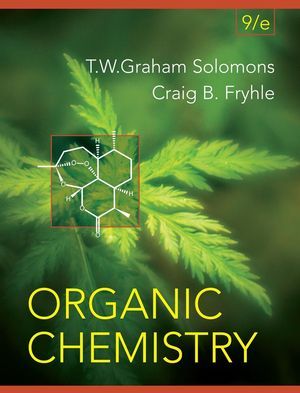
1. Organic Chemistry, 9th ed., Graham Solomons & Craig Fryhle
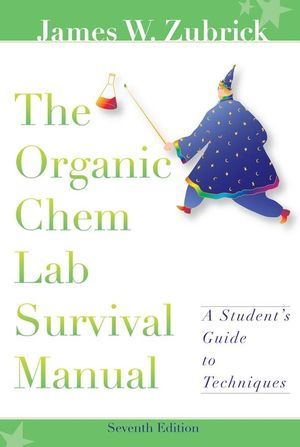
2. The Organic Chem Lab Survival Manual, 7th ed., Zubrick
(Recommended) Study Guide to Organic Chemistry, 9th ed., Solomons & Fryhle
| Prof. Irvin J. Levy Office Hours: MWF, 8:00-9:00am, 12:30-1:00pm T, 8:00-9:30am; or by appointment |
It's good to be green! - K. |
TEXTS
1. Organic Chemistry, 9th ed., Graham Solomons & Craig Fryhle
2. The Organic Chem Lab Survival Manual, 7th ed., Zubrick
(Recommended) Study Guide to Organic Chemistry, 9th ed., Solomons & Fryhle
ADDITIONAL MATERIALS
1. Bound notebook for laboratory
2. Safety goggles as required by Department
3. Protective gloves
(Recommended) Darling Flexible Stereochemical Models
MODES OF EVALUATION
Organic Chemistry is very much like a language. As with any language, mastery is only possible with regular practice. Accordingly, homework assignments following the enclosed Class Schedule will be given daily. It is expected that the assignment will be completed before the next lecture. Homework will be assigned to help clarify important concepts; however, homework will not be collected and will not directly affect the course grade. Homework does, of course, affect the grade in that it is unlikely that the course content can be mastered without significant practice. Self-evaluation of homework will be possible through the use of the Study Guide.
A brief quiz covering recent lecture material will normally be given at the beginning of every other class period. The first quiz will occur on the fourth day of class. Regular attendance is, thus, necessary to achieve success in the course. The three lowest quiz scores will be discarded when calculating the final quiz score. Make-up quizzes will not be administered under any circumstances. All quizzes are closed-book, closed notes.
Since the ability to communicate effectively is a key to success in scientific endeavors, a writing assignment (the Green Organic Literacy forum, or GOLum) is an important element in this course. GOLum will engage a team of several students in the preparation of a useful end product to communicate the principles of green chemistry to an audience external to this course. Important note: this is not a standard research paper. Please refer to the section below which describes the style of the assignment before proceeding! A list of possible topics/audiences is provided; however, individual interests may be pursued with permission. While content is extremely important, this assignment will also be evaluated in terms of form of presentation. Due to the complexity of this project, several intermediate milestones are due (sse handout). Failure to observe these due dates will result in a one-half letter grade reduction in the final project grade for each milestone missed. Handwritten milestones will not be accepted. The final project is due as shown on the Class Schedule below. Late submissions will be penalized one letter grade for each day (or portion thereof) late - "Big mistake. Big. Huge."
Three Opportunities will be administered on the dates listed below. Make-ups will be given only under extreme circumstances (illness, serious personal difficulty). Opportunity #2 is a take-home, open-book assignment which will require a great deal of time on the week of March 20 to March 27. Please arrange to have a minimum of 10 hours to devote to this assignment. Individual students sometimes choose to work far beyond this suggested amount of time.
The final examination will be a multiple choice standardized American Chemical Society examination which is cumulative over both courses. Any student scoring at the national 90th percentile or higher on the this exam will automatically receive a grade of A in the course provided all laboratory work has also been completed.
Laboratory work will be assessed in the following way. A student is expected to attend all labs (or makeup assignment if missed through excusable absence), properly utilize a laboratory notebook (which will be subject to examination without notice), show evidence of preparation for lab (through lab quizzes, flowcharts, etc.), and strictly adhere to all chemical hygiene rules. It is usually very difficult to make up missed labs, thus it is essential that lab attendance be very faithful. The lab grade begins at 100% and will be decreased by 10% for each nonperformance of the expected standards. After a one time grace period (no penalty), upon violation of a chemical hygiene rule, the student will be asked to leave the lab for the remainder of the class period. This will result in two reductions to the lab grade (chemical hygiene violation, nonexcused absence).
Laboratory notebooks will be prepared by the student and will be assessed by a combination of self-evaluation and peer-evaluation (neither of which will affect the actual grade in the course) and by evaluation by the lab instructor. Students who perform all laboratory work, observe all chemical safety regulations, and maintain an acceptable laboratory notebook will receive full credit for laboratory effort (representing 67% of the lab grade). During the final laboratory session, a laboratory examination will be administered. The score on this examination represents 33% of the lab grade.
Scores on graded materials are not curved. Final grades will be computed as follows:
30% - Three Opportunities
15% - Quizzes (drop three low scores)
20% - Laboratory (includes lab exam)
20% - GOLum
15% - Final examination (curved)
GREEN ORGANIC LITERACY FORUM (GOLum) ASSIGNMENT
Last semester was a time to gather with a team and develop a plan for a GOLum project. This semester you will bring your project to completion. Several important dates apply to the various milestones in the project. The timely submission of all items is essential to success in the project. Details of the milestones follow. Milestones will only be accepted electronically (unless previously arranged) by submission to greenchemistry@comcast.net with all needed files attached. All milestones are due no later than 5pm on the due date. Submissions received after the 5pm deadline will be penalized.
Milestones
In this milestone you will report the following:
You prepared an annotated bibliography last semester. You are to revise it by adding all new resources that you have discovered and by deleting resources that were on the original bibliography that you no longer believe are useful. Remember that you should include a descriptive entry for every web site, article, book, handout, and person (other than your team members or your professor) that is relevant to your project. You are to resubmit your Team Report (from the previous milestone) noting what tasks have been accomplished and altering the timeline as needed. Add a paragraph that clearly states change in the report from the previous version and the reason for those changes.
During the months of March and April, projects will be nearing completion. Teams will need peer support to complete their projects. For example, if students produce a video, they will need others to critique their script or raw footage; if students produce written materials, they will need others to critique their written work; if students prepare new lab activities, they will need others to test their activities; if students are visiting a high school, they will need an audience on our campus to run a "dress rehearsal". Each student in the class will be required to perform three (3) critiques in support of their peers. In order for a critique to count, the student must first confirm (verbally) with the professor that the critique is permitted (for example, I can't have 20 people critique the same video!). Unless otherwise directed, credit is received when the student sends a WRITTEN critique to all members of the team along with a copy to greenchemistry@comcast.net. In order to receive credit, the written critique must be submitted within seven (7) days of the peer review.
| Name of project and team members Brief bio statements (with photos) and abstract | 1 page maximum |
| Description of the audience | about 1 page |
| Description of the presentation forum | about 1 page |
| Mirror: Copies of all material presented for the audience | variable, 5-15 pages |
| Final annotated bibliography | variable, 1-10 pages |
| Final action plan | 1-2 pages |
| Written critiques from peers | 1-3 pages |
| Your own critique, analysis of outcomes, suggestions for future work | 1-2 pages |
MISCELLANEOUS INFORMATION
Make-up examinations will be allowed only if the absence is previously cleared with the instructor or in the event of an emergency. In the case of illness, a written excuse from the health center is required. In the case of a personal emergency, a note from the Center for Student Development is required.
Make-up quizzes are not administered under any circumstances. Really. We drop low quiz scores, though.
|
Students with disabilities who may need academic accommodations
should follow this procedure:
Your failure to register in time with your professor and the ASC may compromise our ability to provide the accommodations, so please follow the above procedure. Questions or disputes about accommodations should be immediately referred to the Academic Support Center. Gordon College is committed to assisting students with documented disabilities. If you have a disability, it is essential that you obtain appropriate documentation of the disability and that you understand the accommodations, appropriate to the specific disability, to which you are entitled. |
PRACTICE EXAMINATIONS (EXTERNAL WEBSITES)
| Meeting(s) | Chapter | Topic |
|---|---|---|
| Jan 13 | 11.1-6,10 | Alcohols: Reactions involving the O-H bond Quickstart assigned |
| Jan 15 | 11.7-9,11,13 | Alcohols: Reactions involving the R-O bond |
| Jan 18 | --- | NO CLASSES - MARTIN LUTHER KING DAY |
| LAB Jan 19 | handout | Sodium borohydride reduction of a ketone: Preparation of meso-hydrobenzoin |
| Jan 20 | 11.12,14,15,17 | Ether reactions GOLum Milestone Due--Team Report |
| Jan 22 | 12.1-3 | Introduction to Organic redox reactions Reductions: Alcohols from carbonyl compounds. |
| Jan 25 | 12.4 | Oxidations: Synthesis of carbonyl compounds. |
| LAB Jan 26 | handout | Selective Oxidation of Benzyl Alcohol |
| Jan 27 | 12.5-8 | The Grignard Reaction Milestone #1 due |
| Jan 29 | --- | concluded |
| Feb 1 | 13.1-5 | Conjugated Unsaturated Systems The Game of Resonance |
| LAB Feb 2 | handout | Grignard Reaction: Preparation of Triphenylmethanol |
| Feb 3 | --- | continued |
| Feb 5 | --- | continued |
| Feb 8 | 13.6-11 | Dienes and the Diels-Alder Reaction |
| LAB Feb 9 | handout | Aqueous Diels-Alder Reaction |
| Feb 10 | --- | continued |
| Feb 12 | 14 | Aromaticity |
| Feb 15 | --- | concluded |
| LAB Feb 16 | handout | Synthesis of Iodovanillin |
| Feb 17 | 15 | Reactions of aromatic compounds GOLum Milestone due-Revised Annotated Bibliography & Revised Team Report |
| Feb 19 | --- | * * * OPPORTUNITY #1 * * * |
| Feb 22 | --- | continued |
| LAB Feb 23 | --- | EAS continued |
| Feb 24 | --- | continued |
| Feb 26 | --- | continued Milestone #3 due |
| Mar 1 | --- | continued |
| LAB Mar 2 | J. Chem. Educ. article | Microwave-Assisted Synthesis of a Natural Insecticide |
| Mar 3 | --- | concluded, at last! |
| --- | --- | Spring Break |
| Mar 15 | 16 | Aldehydes and ketones I. Nucleophilic addition to the carbonyl group |
| LAB Mar 16 | --- | Synthesis Team Projects |
| Mar 17 | --- | Wolff-Kishner Reduction, Link 1, Link 2 |
| Mar 19 | --- | Olefin Methathesis, Link 1, Link 2 * * * OPPORTUNITY #2 AVAILABLE * * * |
| Mar 22 | --- | No lecture GOLum Work Time |
| LAB Mar 23 | Solomons 9.1-9.11C (skip 9.5, 9.9D) Practice problems: 9.28 | NMR video DUE ON FRIDAY AS PART OF OPPORTUNITY #2: Link |
| Mar 24 | --- | No lecture GOLum Work Time |
| Mar 26 | --- | concluded * * * OPPORTUNITY #2 COLLECTED * * * |
| Mar 29 | 17 | Aldehydes and ketones II. Enolate reactions |
| LAB Mar 30 | --- | Continue Team Projects |
| Mar 31 | --- | continued |
| Apr 2 | --- | concluded |
| Apr 5 | 18 | Carboxylic acids and their derivatives Nucleophilic addition-elimination at the acyl carbon |
| LAB Apr 6 | --- | Continue Team Projects |
| Apr 7 | --- | continued |
| Apr 9 | --- | Easter Break |
| Apr 12 | --- | Easter Break |
| LAB Apr 13 | --- | Conclude Team Projects |
| Apr 14 | 18 | continued |
| Apr 16 | --- | concluded |
| Apr 19 | 19 | Synthesis and reactions of β-dicarbonyl compounds |
| LAB Apr 20 | handout | Biginelli Reaction |
| Apr 21 | --- | concluded GOLum Binder Is Due! |
| Apr 23 | 20 | Amines |
| Apr 26 | --- | * * * OPPORTUNITY #3 * * * |
| LAB Apr 27 | --- | Lab Exam/Check-out |
| Apr 28 | 21 | Amines, concluded |
| Apr 30 | --- | Phenols and aryl halides Nucleophilic aryl substitution |
| May 3 | --- | continued |
| May 4 | --- | Thursday schedule, No Organic Lab |
| May 5 | --- | Conclusion, Prep for final Poster day for Synthesis Teams |
| Monday, May 10 2:00 pm - 4:00 pm | --- | * * * FINAL EXAMINATION * * * |