ORGANIC CHEMISTRY II
Chemistry 213
Salem State College, Spring 2001
Prof. Irvin J.
Levy
Lecture: Tu 5:00-7:45pm
Laboratory: Tu 8:00-10:00pm
The two semester course in Organic Chemistry will seek to develop an appreciation
of the
importance of carbon chemistry in our lives and in our world. In a practical
light, we will endeavor
to acquire a level of expertise in the theoretical and actual manipulation of
carbon compounds. This second semester course assumes a working knowledge of the
material from the first semester of the course.
REQUIRED MATERIALS AND RECOMMENDED MATERIALS
(Note: same as Fall, no new materials required)
TEXTS
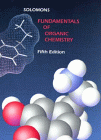
1. Fundamentals of Organic Chemistry, 5th ed., T.W. Graham Solomons
2. Organic Chemistry Laboratory, Rodig, Bell and Clark
(Recommended) Study Guide to Fundamentals of Organic Chemistry, 5th ed.,
Solomons
ADDITIONAL MATERIALS
1. Bound notebook for laboratory
2. Safety goggles as required by Department
3. Protective gloves
COURSE STRUCTURE
Daily effort through reading and problem solving is essential to success in this
course. Specific
assignments following the enclosed Class Schedule will be
given weekly. It is expected that the
assignment will be completed before the next lecture. Homework will not be
collected; however,
in order to provide continuing motivation, each lecture will begin with a brief
quiz based upon the
previous assignment. Self-evaluation of homework will be possible through the
use of the Study
Guide.
CRITERIA FOR EVALUATION
Two Opportunities will be offered on the dates listed in the enclosed Class Schedule. Make-up
opportunities are not available. The final examination is an American Chemical Society standardized examination. The results of this examination are curved. Any student who scores at the 90th percentile or higher on this examination will receive an automatic grade of A in the course, providing the laboratory has been succesfully completed.Two low quiz scores will be dropped when
computing the final
quiz grade. Make-up quizzes are not available.
Laboratory work will be assessed in the following way. A student is expected to
attend all labs (or
make-up assignment if missed through excusable absence), properly utilize a
laboratory notebook
(which will be subject to examination without notice), show evidence of
preparation for lab
(through lab quizzes, flowcharts, etc.), and strictly adhere to all chemical
hygiene rules. It is
usually very difficult to make up missed labs, thus it is essential that
attendance be very faithful.
The lab grade will be decreased by 10% for each nonperformance of the expected
standards. After
a one time grace period (no penalty), upon violation of a chemical hygiene rule,
the student will be
asked to leave the lab for the remainder of the class period. This will result
in two reductions to the
lab grade (chemical hygiene violation, nonexcused absence).
Laboratory notebooks will be critiqued by self-evaluation, peer-evaluation
(neither of which will
affect the lab grade) and discussion with the professor which will affect the lab
grade.
Additionally, during the last laboratory session, a laboratory exam will be
administered. The lab
grade will be determined as follows:
0% -
Self-evaluation, Peer-evaluation
67% - Professor's
evaluation
33% - Laboratory
examination
Overall grades will be computed as follows:
15% - Opportunity
#1
15% - Opportunity
#2
20% - Final Examination
30% - Quizzes
20% - Laboratory
Both lecture and laboratory must have passing grades in order for a passing grade
in the course.
Please note: The evening course in organic chemistry is a challenging course which requires continual effort outside the classroom. Our class covers the same material each evening as a normal week of class on a MWF schedule. Between lecture, laboratory, reading and homework problems you should plan to spend about 15 hours per week working on this class. If you are not able to make this significant time commitment your final result is likely to be very poor. Please make time to allow for success.
Laboratories during the second semester use the techniques introduced during the
first semester to develop continued depth of skill in the chemistry laboratory.
Students will be challenged to think critically about their work and to take
significant responsibility for planning their use of time in the lab.
Tentative Class Schedule
| Date | Chapter | Topic |
|---|
|
| January 16 | 10 | Alcohols & Ethers |
| --- | Lab: New Students ONLY |
| | Introduction to Organic Laboratory; Check-in |
|
| January 23 | 11 | Oxidation & Reduction of Carbonyl Compounds
The Grignard Reaction |
| handout | Lab: Grignard synthesis of triphenylmethanol |
|
| January 30 | 12 | Resonance - Conjugation - Delocalization - Stability |
| handout | Lab: Infrared spectroscopy of a known compound |
|
| February 6 | 14 | Aromaticity |
| handout | Lab: Infrared spectroscopy of an unknown compound |
|
| February 13 | --- | * * * OPPORTUNITY #1 * * * |
| 15 | After Opportunity: Electrophilic Aromatic Substitution (EAS) |
| 28.A | Lab: Preparation of p-nitroaniline |
|
| February 20 | 15 | EAS: Conclusion; Side-chain reactions |
| 28.A | Lab: Purification of p-nitroaniline |
|
| February 27 | 16 | Aldehydes and Ketones: Synthesis; Nucleophilic addition |
| handout | Lab: Identification of unknown aldehyde or ketone |
|
| March 6 | 16 | Aldehydes and ketones: Wittig reaction; Ammonia addition compounds |
| handout | Lab: Identification of unknown aldehyde or ketone |
|
| March 13 | --- | * * * SPRING BREAK * * * |
|
| March 20 | 17 | Enolate Chemistry: Introduction to aldol reaction |
| handout | Lab: Identification of unknown aldehyde or ketone |
|
| March 27 | 17 | Enolate Chemistry: Modifications to the simple aldol reaction |
| handout | Lab: Identification of unknown aldehyde or ketone |
|
| April 3 | --- | * * * OPPORTUNITY #2 * * * |
| 13 | After Opportunity: Nuclear Magnetic Resonance Spectroscopy (NMR) |
|
| April 10 | 18 | Carboxylic acids and their derivatives (introduction) |
| handout | Lab: Preparation of soap: Large-scale organic synthesis |
|
| April 17 | 18 & 19 | Carboxylic acids and their derivatives (conclusion)
Acetoacetic ester synthesis; Malonic ester synthesis |
| --- | Lab: Catch-up as needed; Notebook reviews |
|
| April 24 | 20 & 21 | Amines (selected topics); Phenols |
| --- | Lab: Laboratory examination; check-out |
|
| May 1 | --- | * * * FINAL EXAMINATION * * * |
|