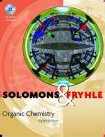
1. Organic Chemistry, 8th ed., Graham Solomons & Craig Fryhle
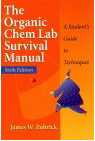
2. The Organic Chem Lab Survival Manual, 6th ed., Zubrick
(Recommended) Study Guide to Organic Chemistry, 8th ed., Solomons & Fryhle
TEXTS
1. Organic Chemistry, 8th ed., Graham Solomons & Craig Fryhle
2. The Organic Chem Lab Survival Manual, 6th ed., Zubrick
(Recommended) Study Guide to Organic Chemistry, 8th ed., Solomons & Fryhle
ADDITIONAL MATERIALS
1. Bound notebook for laboratory
2. Safety goggles as required by Department
3. Protective gloves
(Recommended) Darling Flexible Stereochemical Models
MODES OF EVALUATION
Organic Chemistry is very much like a language. As with any language, mastery is only possible with regular practice. Accordingly, homework assignments following the enclosed Class Schedule will be given daily. It is expected that the assignment will be completed before the next lecture. Homework will be assigned to help clarify important concepts; however, homework will not be collected and will not directly affect the course grade. Homework does, of course, affect the grade in that it is unlikely that the course content can be mastered without significant practice. Self-evaluation of homework will be possible through the use of the Study Guide.
A brief quiz covering recent lecture material will normally be given at the beginning of every other class period. The first quiz will occur on the fourth day of class. Regular attendance is, thus, necessary to achieve success in the course. The three lowest quiz scores will be discarded when calculating the final quiz score. Make-up quizzes will not be administered under any circumstances. All quizzes are closed-book, closed notes.
Three Opportunities will be administered on the dates listed below. Make-ups will be given only under extreme circumstances (illness, serious personal difficulty). The third opportunity will occur during the final examination period established by the registrar. This opportunity will be cumulative over all reactions covered during the semester and will also include sections regarding theory from the chapters which were not previously covered in Opportunity #1 or #2. All opportunities are closed-book, closed-notes.
Laboratory work will be assessed in the following way. A student is expected to attend all labs (or makeup assignment if missed through excusable absence), properly utilize a laboratory notebook (which will be subject to examination without notice), show evidence of preparation for lab (through lab quizzes, flowcharts, etc.), and strictly adhere to all chemical hygiene rules. It is usually very difficult to make up missed labs, thus it is essential that lab attendance be very faithful. The lab grade begins at 100% and will be decreased by 10% for each nonperformance of the expected standards. After a one time grace period (no penalty), upon violation of a chemical hygiene rule, the student will be asked to leave the lab for the remainder of the class period. This will result in two reductions to the lab grade (chemical hygiene violation, nonexcused absence).
Laboratory notebooks will be prepared by the student and will be assessed by a combination of self-evaluation and peer-evaluation (neither of which will affect the actual grade in the course) and by evaluation by the lab instructor. Students who perform all laboratory work, observe all chemical safety regulations, and maintain an acceptable laboratory notebook will receive full credit for laboratory effort (representing 67% of the lab grade). During the final laboratory session, a laboratory examination will be administered. The score on this examination represents 33% of the lab grade.
Scores on graded materials are not curved. Final grades will be computed as follows:
45% - Three Opportunities
30% - Quizzes (drop three low scores)
25% - Laboratory (includes lab exam)
MISCELLANEOUS INFORMATION
Make-up examinations will be allowed only if the absence is previously cleared with the instructor or in the event of an emergency. In the case of illness, a written excuse from the health center is required. In the case of a personal emergency, a note from the Center for Student Development is required.
Make-up quizzes are not administered under any circumstances.
|
Students with Disabilities
Gordon College is committed to assisting students with documented disabilities. (See Academic Catalog Appendix C, for documentation guidelines.) A student with a disability who may need academic accommodations should follow this procedure:
Failure to register in time with your professor and the ASC may compromise our ability to provide the accommodations. Questions or disputes about accommodations should be immediately referred to the Academic Support Center. See Grievance Procedures available from the ASC. |
Laboratories during the first semester focus on development of techniques commonly used in the organic chemistry laboratory. Through these experiences we will learn to perform organic chemical reactions as well as some organic laboratory operations, such as use of ground glass chemical apparatus, melting point determination, recrystallization, decolorization, vacuum filtration, distillation (several types), extraction, drying, evaporation, gas chromatography and infrared spectroscopy.
Note: Laboratory is preceeded by a mandatory pre-lab lecture. Reading: chapter numbers below refer to reading required from The Organic Chem Lab Survival Manual before arriving on the lab day. Handouts will be provided online (links below) or in hard copy. Failure to read the required material before arrival at lab may result in a reduction in the laboratory grade. Unannounced laboratory quizzes will be used as necessary. These will be graded on a Pass/Fail basis. Passing grades will not affect the laboratory grade; however, each failing grade will reduce the final laboratory score by 1/2 letter grade.
| Date | Reading (before class) | Topic |
|---|---|---|
| Aug 30 | --- | Syllabus and Introduction |
| Sep 1 | 1.1-7 | Carbon, bonds & charge |
| Sep 4 | --- | NO CLASS TODAY Labor Day |
| Sep 5 | 1, 2, handout #1 handout #2 | Check-in, Orientation; "Powers of Observation" |
| Sep 6 | 1.9-14 1.16,17, 2.1-4 | Orbitals and hybridization Molecular geometry; Representation of molecules |
| Sep 8 | 2.5-9 | Structure vs. behavior: Introduction to functional groups |
| Sep 11 | handout calculator | NO CLASS TODAY Review of chemical calculations due on Wednesday |
| Sep 12 | No lab this week | |
| Sep 13 | 2.10-13 | Carbonyl compounds |
| Sep 15 | 2.14,15 | Relationships Between Physical Properties and Molecular Structure |
| Sep 18 | 3.1-6 | Acidity and Basicity |
| Sep 19 | 34, handout, Solomons 2.16 | Infrared Spectroscopy: Functional group probe |
| Sep 20 | 3.12-15 | Acids and bases in organic chemistry |
| Sep 22 | 4.1-7 | Alkanes: Nomenclature and Properties |
| Sep 25 | 4.1-7 | Alkanes: Nomenclature and Properties |
| Sep 26 | 3,12, handout | Melting Point Determination and Significance |
| Sep 27 | --- | Synthesis, Backwards first! |
| Sep 29 | 4.16-19 | Synthesis, then Forward! |
| Oct 2 | --- | TBA |
| Oct 3 | 4, 19, 20 (class 1), handout | Simple Distillation Boiling Point Determination |
| Oct 4 | --- | * * * OPPORTUNITY #1 * * * |
| Oct 6 | 4.8,9 | Conformational analysis of linear alkanes |
| Oct 9 | 4.10,11 | Ring strain |
| Oct 10 | 4, 19, 20 (class 3), Dist. handout TopoCalc handout | Fractional Distillation Topological Indices as Predictors of Physical Properties |
| Oct 11 | 4.12-14 | Conformational analysis of cyclohexanes |
| Oct 13 | 5.1-6 | Stereochemistry: Chirality |
| Oct 16 | 5.7 | Stereochemistry: Nomenclature |
| Oct 17 | 6, 9, 11, 13, 17, 18, handout | Synthesis and purification of an organic solid |
| Oct 18 | 5.8-11 | Stereochemistry: Optical activity |
| Oct 20 | --- | No class, quad break |
| Oct 23/td> | 5.12-14 | Conclusion, Stereochemistry |
| Oct 24 | 3, handout | Using the Chemical Literature Drawing Structures with ChemSketch, (download now) |
| Oct 25 | 6.1-4,14 | Reaction types: Nucleophilic substitution |
| Oct 27 | 6.5-8 | Mechanism: The SN2 mechanism |
| Oct 30 | 6.10-12 | The SN1 mechanism |
| Oct 31 | 20 (class 3), handout | Dehydration of 2-Methylcyclohexanol |
| Nov 1 | 6.13 | Competition: SN2 vs. SN1 |
| Nov 3 | 6.15-19 | Competition between types: Substitution vs. Elimination |
| Nov 6 | 7.1-4 | Alkenes and alkynes: Nomenclature and stability |
| Nov 7 | --- | No lab: Day of prayer |
| Nov 8 | 7.5-8 | Alkene synthesis: Zaitsev's rule |
| Nov 10 | 7.9-11 | Alkyne synthesis |
| Nov 13 | 7.12-14 | Hydrogenation revisited |
| Nov 14 | --- | GC of dehydration product |
| Nov 15 | --- | Catch up and preparation for opportunity |
| Nov 17 | --- | * * * OPPORTUNITY #2 * * * |
| Nov 20 | 8.12-14 | Alkene halogenation |
| Nov 21 | --- | Catch-up all unfinished IR/GC/melting points |
| Nov 22 | --- | No class, Prepare for Thanksgiving |
| Nov 24 | --- | No class, Recuperate from Thanksgiving |
| Nov 27 | 8.1-5 | Alkenes and alkynes: Ionic addition; Markovnikov's rule |
| Nov 28 | handout | Green chemistry: Bromination of an alkene | Nov 29 | 8.6 | Oxymercuration/demercuration |
| Dec 1 | 8.7-11 | Organoborane chemistry |
| Dec 4 | 8.15-17 | Alkene reactions with carbene; Oxidation |
| Dec 5 | handout | Synthesis of an alkyne: Diphenylacetylene | Dec 6 | 8.18-21 | Alkyne reactions |
| Dec 8 | 11.1-6,10 | Alcohols: Reactions involving the O-H bond |
| Dec 11 | 11.7-9,11,13 | Alcohols: Reactions involving the R-O bond Ethers |
| Dec 12 | --- | Laboratory Exam; Check-out |
| Dec 13 | 11.12,14,15,17 | Ether reactions |
| Dec 16 | SATURDAY 9:00am-11:00am | * * * OPPORTUNITY #3 * * * |